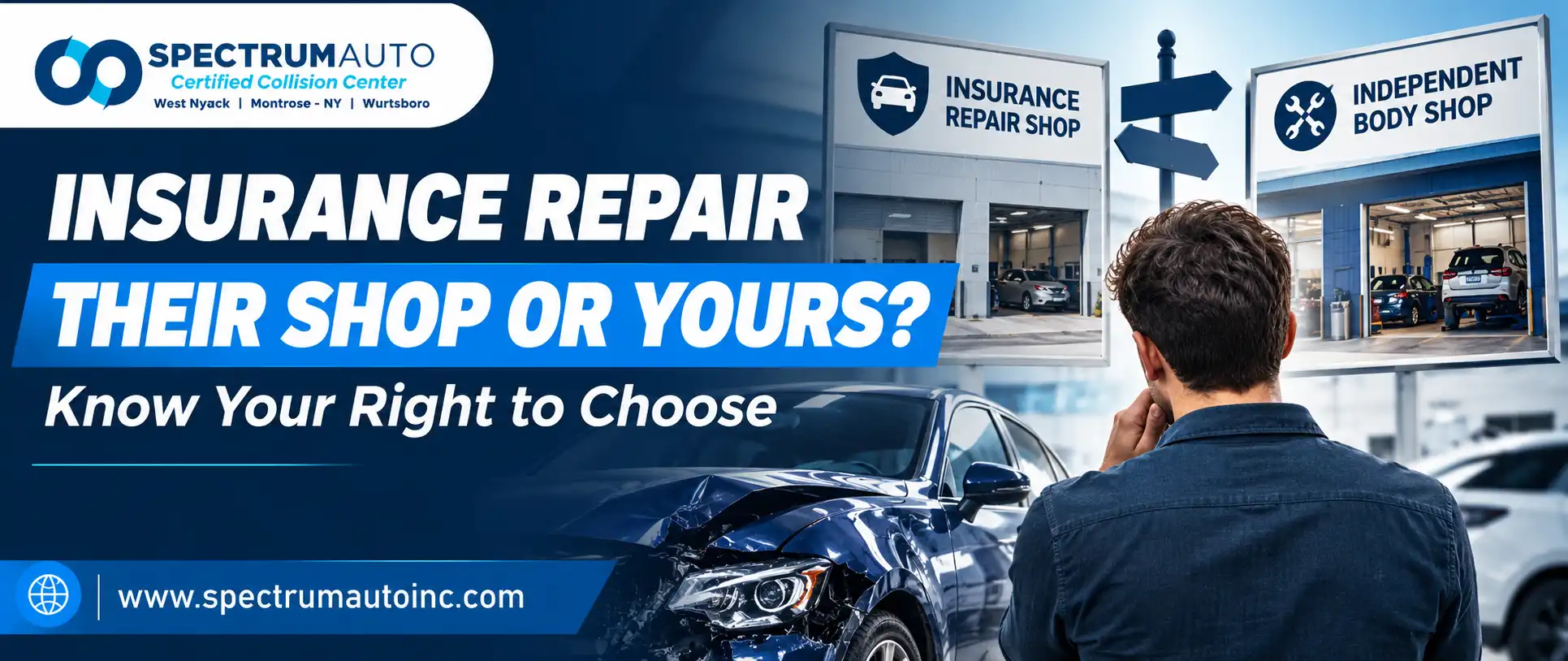
After an accident, your insurer may hand you a list of "approved" shops. It's easy to assume you have to pick from that list. You don't. In New York, you have the legal right to choose your own collision repair shop. This guide explains the difference between an insurer's direct repair shop and an independent collision repair shop, and what that choice actually means for your claim.
In 2026, this question comes up more often, as more insurers build out their preferred-shop networks. Understanding the actual rules, rather than assuming the list you were handed is mandatory, puts you in a stronger position to choose confidently.
What Is an Insurance "Approved" or DRP Shop?
Many insurers maintain a list of shops in a direct repair program, or DRP. These shops have a pre-negotiated relationship with the insurer. The arrangement can speed up the claims process. Estimates and payment often move faster, since the shop and insurer are already used to working together.
A DRP relationship doesn't mean the shop is required by law or the only option available to you. It means the insurer has an existing business relationship with that particular shop. The insurer benefits from predictable pricing and faster claim turnaround.
DRP shops often use estimating software that's integrated with the insurer's claims system. That integration can shave time off the paperwork side of a repair. It doesn't necessarily reflect anything about the shop's technical skill, certifications, or the quality of the finished repair.
What Is an Independent Collision Repair Shop?
An independent collision repair shop has no contractual relationship with any specific insurer. It may still work with every major insurance company on individual claims. The difference is in the relationship, not the service offered. Many independent shops carry the same certifications as DRP shops. I-CAR Gold Class training and OEM-specific credentials are common at both types of shops.
Choosing an independent collision repair shop doesn't mean giving up insurance coordination. Most independent shops handle claims paperwork and communicate directly with your adjuster, just as a DRP shop would.
Some drivers choose an independent shop because they've used it before, it's closer to home, or a family member or trusted mechanic recommended it. Others choose independent shops specifically because they're not tied to insurer pricing preferences, which can matter if you want OEM parts rather than aftermarket alternatives.
Your Right to Choose in New York
New York law is clear on this point. Insurers cannot require you to use a specific shop.
"New York Insurance Law Section 2610(a) gives vehicle owners the right to choose their own repair shop for collision-related repairs, regardless of which shop an insurer recommends." New York State Insurance Law §2610(a)
An insurer can still recommend a shop from its DRP network. It can explain the potential benefits of that choice. What it cannot do is deny your claim or limit your coverage simply because you pick a different collision repair shop. If an insurer implies otherwise, that's worth questioning directly with your claims adjuster.
If pressure continues, politely confirm your choice of shop and ask the representative to point to the specific policy language requiring a particular shop. In most cases, no such requirement exists, and the conversation ends there. Keeping a brief note of the exchange is a reasonable precaution if you have ongoing concerns about how your claim is being handled.
Common Myths About Insurance-Recommended Shops
A few misconceptions come up often enough to address directly.
Myth: You must use the shop your insurer names. This isn't true in New York. You can choose any licensed collision repair shop in New York you prefer. Your insurer can suggest a shop, but it cannot require you to use one.
Myth: Your claim will be denied if you go elsewhere. A legitimate claim, properly documented, doesn't get denied because of which shop you picked. If a representative implies otherwise, ask for that policy in writing, since it generally doesn't exist.
Myth: Independent shops are always more expensive. Pricing depends on the repair itself, not the shop's DRP status. Comparing a few estimates is the only reliable way to know which option costs less for your specific repair.
Myth: Using a non-DRP shop means paying out of pocket upfront. This isn't automatically true. Most shops, DRP or independent, bill the insurer directly for the covered portion of a repair. You're typically only responsible for your deductible, regardless of which shop you choose.
Insurance DRP Shop vs. Independent Shop: Key Differences
| Factor | Insurance DRP Shop | Independent Shop |
|---|---|---|
| Relationship with insurer | Pre-negotiated, direct | No formal contract, case-by-case |
| Claims paperwork speed | Often faster due to existing workflow | Can be just as fast with an experienced shop |
| Certifications | Varies by shop | Varies by shop |
| Your choice of parts and process | May follow insurer preferences | Typically more flexibility |
| Legal requirement to use | Not required | Not required |
Certifications and reputation matter more than DRP status alone. A shop's direct insurer relationship says little about the quality of its actual repair work.
Consider a driver whose rear bumper and quarter panel were damaged in a parking lot collision. Their insurer suggested a DRP shop fifteen minutes away. The driver instead chose a local shop with strong reviews and I-CAR Gold Class certification, a few minutes closer to home. The claim moved forward the same way either option would have: an estimate, insurer review, and approval. The main difference was where the driver dropped off and picked up the vehicle, and which technicians handled the repair.
What to Weigh Before Deciding
Both options can be reasonable, depending on your priorities. Some drivers value the speed a DRP relationship can offer. Others prioritize a specific shop's reputation, certifications, or convenience. Neither priority is wrong. The key is making an informed choice rather than assuming you're locked into whatever list your insurer hands you.
A few questions can help you decide:
- Does the shop carry current I-CAR or OEM certifications relevant to your vehicle?
- Can the shop perform ADAS recalibration in-house, if your vehicle requires it?
- Does the shop communicate claims status directly with your insurer, regardless of DRP status?
- What do recent, verifiable reviews say about the shop's communication and repair quality?
- What warranty terms apply to the completed repair?
A shop's answers to these questions tell you more than whether it happens to be on your insurer's list.
It's also worth thinking about convenience. A collision repair shop in New York closer to your home or workplace can make drop-off and pickup easier, especially if your repair takes several days. Multi-location shops can offer flexibility here, letting you choose whichever location fits your schedule best while still working with the same certified team.
"ADAS recalibration is essential after any collision or glass replacement that shifts the position of a camera or radar sensor, since even minor misalignment can change how these systems read the road." National Highway Traffic Safety Administration (NHTSA)
How Your Choice Affects the Claim and Warranty
Choosing a non-DRP collision repair shop doesn't void your coverage. Your policy still applies the same way. One practical difference: a non-DRP shop may need to submit its own estimate for insurer review, rather than working from a pre-approved pricing structure. This can occasionally mean a short delay while the estimate is reviewed, though it isn't guaranteed.
Warranty terms come from the repair shop, not the insurer, in most cases. Ask any shop you're considering, DRP or independent, what warranty covers the parts and labor on your specific repair.
If your vehicle has Advanced Driver Assistance System (ADAS) features, confirm the shop's calibration process regardless of DRP status. Recalibration isn't guaranteed just because a shop works with your insurer. It depends on the shop's own equipment and technician training, so it's worth asking directly.
Parts choice is another area where DRP status can play a role. Some DRP agreements include an expectation around aftermarket or recycled parts for certain repairs, to help control costs. You generally still have a say in this decision, and many insurers allow an upgrade to OEM parts, sometimes at an added cost to you. An independent shop may have more flexibility here by default, but the specifics always come down to your individual policy.
A Practical Way to Decide
Start by getting an estimate from the shop your insurer suggests. Then get a second estimate from an independent collision repair shop you're considering. Compare certifications, communication, and the specifics of each estimate, not just the final number. A shop willing to walk you through its process, explain parts choices, and answer questions about ADAS recalibration is usually a good sign, regardless of its DRP status.
If the two estimates differ significantly, ask both shops to explain why. A reasonable explanation, tied to parts or labor scope, is a good sign. A vague answer is worth following up on before you commit.
"I-CAR Gold Class recognition requires a collision repair business to have specific roles filled by technicians who have completed required, role-specific training — an industry benchmark for repair proficiency." I-CAR (Inter-Industry Conference on Auto Collision Repair)
Working With Multiple Insurers as an Independent Shop
A shop doesn't need a DRP relationship with every insurer to work smoothly with them. Many independent and multi-certified shops handle claims from dozens of different carriers every year. They build their own internal process for estimates, documentation, and adjuster communication that works across insurers, rather than depending on one insurer's specific workflow.
This matters if you're choosing a shop for its certifications or reputation, but your insurer isn't one it has a formal DRP relationship with. Ask the shop directly how often it works with your specific insurer and what that process typically looks like. An experienced shop should be able to answer clearly, even without a formal DRP agreement in place.
Conclusion
You are not required to use your insurer's recommended shop. New York law protects your right to choose. Whether you go with a DRP shop or an independent collision repair shop, focus on certifications, communication, and warranty terms rather than DRP status alone. A collision repair shop in New York that explains its process clearly, without pressure, is one worth trusting with the repair.
Frequently Asked Questions
Can my insurer deny my claim if I don't use their recommended shop?
No. Under New York Insurance Law Section 2610(a), your insurer cannot deny or reduce your claim simply because you chose a shop outside its DRP network. Coverage is based on your policy, not your choice of repair shop.
Will repairs cost more at an independent shop than a DRP shop?
Not necessarily. Pricing depends on the specific repair, the shop's labor rates, and the parts used, not simply whether the shop has a DRP relationship. Getting an estimate directly from the shop is the only way to know for your vehicle.
Does choosing a non-DRP shop slow down my claim?
It can occasionally add a short step, since a non-DRP shop typically submits its own estimate for insurer review. In many cases, the difference is minimal, especially with a shop experienced in working with insurers.
Request a Free Estimate
Request a Free Estimate from Spectrum Auto and get clear answers about your repair options, DRP or not, from estimate to final quality check. Request a Free Estimate to get started.