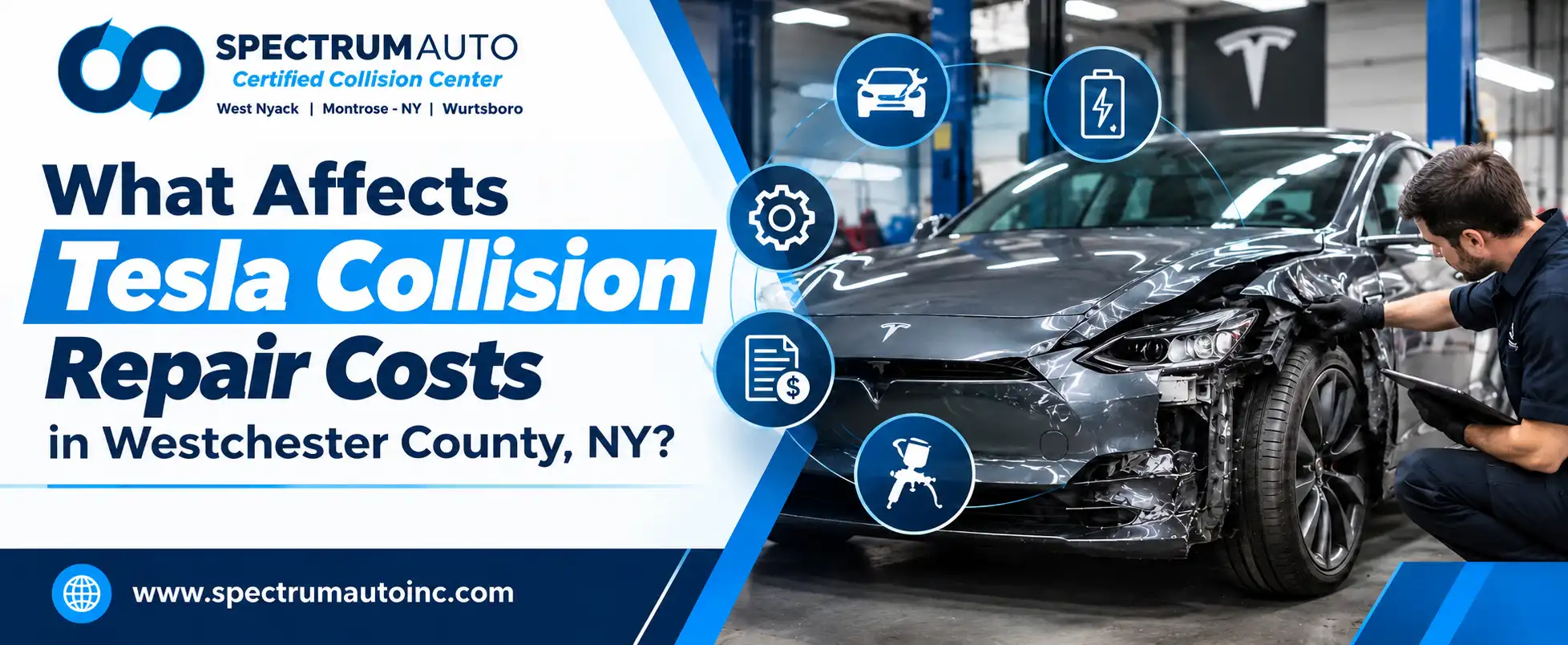
A Tesla repair needs more than a standard body shop can offer. Aluminum panels, high-voltage batteries, and camera-based safety systems all demand specialized training.
This guide explains what separates a true tesla approved collision center in Rockland County from a general auto body shop. That difference affects your car's safety, your insurance claim, and your vehicle's resale value down the line.
A documented, manufacturer-approved repair history can matter later if you ever sell the car or file a warranty claim. That paperwork is one more thing a regular auto body shop often can't provide.
Why Tesla collision repair isn't like repairing a gas-powered car
Collision repair data backs up what many Tesla owners already suspect. EV repairs simply cost more than gas-vehicle repairs on average, and the gap isn't small.
"EV collision repairs cost nearly 20% more than comparable gas-vehicle repairs. The average EV claim ran $5,753, against $4,806 for a combustion vehicle." — Mitchell International, Q2 2024 Industry Trends Report
Mitchell's data points to one factor above the rest. EVs used genuine manufacturer parts for 89% of parts spending, against 65% for combustion vehicles.
Tesla's aluminum body panels need different welding techniques and tools than steel. A shop without that equipment can't safely return the vehicle to factory specifications.
"Tesla's 2017 body shop equipment standards priced structural repair benches up to $27,878, not counting training or facility costs." — Collision Repair Magazine, 2017
That figure is nearly a decade old now, and equipment costs rarely fall over time. A shop can't earn Tesla-approved status without that investment.
High-voltage batteries add another layer of risk. A technician has to safely disable the battery system before touching structural components. That requires manufacturer-specific training most general shops skip.
Cameras and sensors for Autopilot and basic safety features also need precise recalibration after almost any collision repair. Skipping that step can leave safety systems silently out of alignment.
A structural repair with recalibration and backordered parts can take your car off the road for weeks, not days. Check your policy's rental coverage limits before you need them. Many policies cap daily reimbursement below what a comparable rental actually costs.
What it takes to become a tesla approved collision center in Rockland County
Tesla audits a shop in person before granting approval, and few shops pass that audit on the first attempt. The shop must meet strict equipment, training, and documentation standards.
Technicians need manufacturer-specific instruction before they can safely work on a high-voltage system. That training has to happen before a technician ever touches your car.
Certification also isn't permanent. Tesla requires recurring training and periodic re-audits to keep a shop's status current. So an approved shop keeps earning that status year after year.
Manufacturers also publish official repair procedures for specific damage scenarios. A shop that pulls up the exact procedure for your vehicle is following Tesla's standard in the fullest sense. That beats relying on general training alone.
What happens during a Tesla collision repair, step by step
A Tesla-approved repair usually starts with a teardown inspection, not just a visual estimate. The shop removes affected panels to check for damage that doesn't show on the surface. Insurers often need an updated estimate once the full scope is clear.
Parts ordering follows next, and genuine Tesla parts sometimes take longer to arrive than aftermarket alternatives. The shop should tell you upfront if a part is backordered, rather than letting the timeline slip quietly.
Final steps include ADAS calibration, a quality inspection, and a road test when the repair affects handling or safety systems. A shop confident in its process walks you through each step before handing back the keys.
What makes Spectrum Auto Inc different from a regular auto body shop
Spectrum Auto Inc. operates its main facility at 175 NY-303 in West Nyack. It holds genuine Tesla-approved status, not just a general collision repair license. That status sits alongside more than 15 other OEM and specialty certifications.
- Genuine Tesla-approved certification, audited in person by the manufacturer
- I-CAR Platinum credentials for technicians and I-CAR Gold Class facility status
- Aluminum-specific equipment and welding tools, separate from standard steel-body tools
- In-house high-voltage battery safety training for technicians
- Direct repair relationships with Allstate, State Farm, Travelers, and GEICO, which can speed up claim approval
- Written warranty on completed repairs, plus courtesy loaner vehicles on longer jobs
- Additional certified locations in Cortlandt, New City, Nanuet, and Blauvelt
A regular auto body shop can still do excellent cosmetic work. It usually can't match that specific combination of manufacturer audit, high-voltage training, and aluminum-specific equipment, though.
Google reviewers rate the shop 5.0 across roughly 1,000 reviews. Clear communication and certified repair work come up most often in that feedback.
Spectrum also handles structural repair, aluminum body work, and paint matching under one roof. It doesn't split those specialties across different shops. For Tesla work specifically, that matters. Structural and cosmetic repairs on the same vehicle sometimes need different standards at once.
What Tesla collision repair typically costs
None of this is a fixed price without inspecting the vehicle first. Hidden damage behind a bumper or sensor housing often changes the scope once teardown starts.
Genuine Tesla parts generally cost more than generic aftermarket alternatives, especially for structural components. That difference is usually smaller on simple cosmetic panels, where a shop may still offer an aftermarket option on request.
Calibration work adds its own line item on many repairs now. A detailed estimate should break out parts, labor, and calibration separately, which makes it easier to compare two shops fairly.
Every insurer sets a point where repair cost outweighs a vehicle's value. Once an estimate crosses that line, the insurer typically declares the car a total loss instead of approving the repair. Tesla's higher repair costs can push an older vehicle toward that threshold sooner than a comparable gas car.
ADAS calibration: a step many regular shops can't perform
Most Teslas rely on cameras and sensors for Autopilot, automatic emergency braking, and lane-keep assist. A bumper or windshield repair can knock these out of alignment without any visible sign.
Recalibrating them correctly needs dedicated equipment most general shops don't own. Tesla's certification process requires an approved shop to handle that calibration correctly, as part of what the audit covers.
Ask any shop directly whether a quote already includes recalibration. A quote that leaves it out can look lower, right until the shop adds the step back in later.
Rockland County geography and why a nearby certified shop matters
Rockland County packs distinct communities into a small footprint. Routes 59, 303, 9W, and the Palisades Interstate Parkway connect most towns within a short drive.
West Nyack sits near the county's center, with Nanuet, New City, and Spring Valley all close by. Spectrum's additional locations in Cortlandt and Blauvelt extend that reach toward Westchester and the county's northern edge.
A shorter tow distance after an accident matters for a damaged Tesla specifically. Towing, rather than driving, protects the battery housing from further harm until a certified shop can inspect it.
Local driving patterns matter for cost, too. Tighter merges and heavy traffic near West Nyack and Nanuet create more fender-benders than high-speed structural crashes. Cosmetic repairs stay common and relatively affordable, while structural repairs are rarer but costlier.
The Mario M. Cuomo Bridge connects Rockland County to Westchester. That's one reason Spectrum maintains certified locations on both sides of that crossing. A shop with that kind of regional footprint can usually offer a shorter tow distance than a single-location competitor.
Insurance and your right to choose a certified shop
Many drivers assume their insurer picks the repair shop automatically. New York law says otherwise. Under New York Insurance Law §2610, an insurer can't require a specific shop for most claims.
That right applies whether you choose a Tesla-approved shop or a general body shop. Confirm your specific policy terms with your insurer regardless, since coverage details vary by carrier.
What to ask before choosing a Tesla collision repair shop
A few direct questions separate a genuine Tesla-approved shop from one that just says so. Ask each shop the same set before you commit.
- Does the shop hold current Tesla-approved certification, and at which tier?
- Will the repair use genuine Tesla parts, and for which components specifically?
- Does the shop perform ADAS calibration in-house, or send that out?
- What does the written warranty cover, and for how long?
- How does the shop handle hidden damage discovered after teardown begins?
A shop that answers clearly, without hedging, is usually the more trustworthy choice. Treat any phone estimate as a starting point, never a final number.
Final thoughts: choosing Tesla collision repair in Rockland County
A regular auto body shop can handle plenty of repairs well. Tesla-specific work needs a narrower set of equipment, training, and manufacturer approval that not every shop has earned. Not every shop can call itself a tesla approved collision center. That distinction matters most for structural or battery-adjacent damage.
A tesla approved collision center in Rockland County should walk you through its certification and equipment. It should also explain its process before you commit. Spectrum Auto Inc. meets that standard at its West Nyack facility and its additional locations nearby.
When in doubt, ask for the certification's exact name and ask how recently it was renewed. A confident shop will give you a straight answer.
Use the checklist above as your starting point for that conversation. A few extra minutes of questions now can save a repeat repair later.
Frequently asked questions
Q: Is a Tesla-approved shop always better than a regular body shop for cosmetic work?
Not necessarily. A simple scuff or dent often doesn't need Tesla-specific equipment. Structural, battery-adjacent, or sensor-related damage is where the certification actually matters.
Q: Does Tesla collision repair cost more than repairing a gas-powered car?
Often, yes, mainly due to genuine parts and specialized equipment. Industry data points to roughly a 20% premium over comparable gas-vehicle repairs.
Q: Can my insurance company refuse to pay for a certified shop's estimate?
Your insurer reviews any estimate for accuracy, certified or not. A detailed, itemized quote is generally easier for an adjuster to approve quickly.
Q: How do I know if my Tesla needs ADAS recalibration after a repair?
If the repair touched the bumper, windshield, or nearby panels, ask directly. A certified shop can confirm within minutes during inspection.
Q: Does Spectrum Auto Inc serve Tesla owners outside West Nyack?
Yes. It runs additional certified locations in Cortlandt, New City, Nanuet, and Blauvelt. That covers most of Rockland County and nearby parts of Westchester.
Q: Does a Tesla's warranty affect which shop I should choose for repairs?
It can, especially for a newer vehicle. Some warranty terms reference approved repair procedures for structural work. A certified shop documents its work in a way that supports that history.
Ready to work with a tesla approved collision center in Rockland County? Spectrum Auto Inc. combines genuine Tesla-approved certification with a written warranty and clear communication throughout your repair. Request a free estimate today.