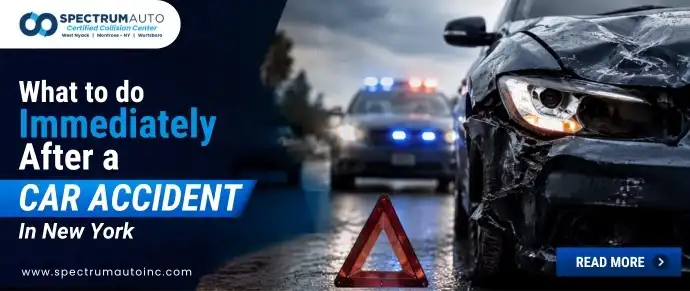
A car accident can happen in seconds, but the minutes that follow often feel like a blur. Your heart is racing, your thoughts are scattered, and you may not be sure what to do first. That reaction is completely normal. The good news is that a few clear steps can protect your safety, your rights, and your vehicle, even when everything feels chaotic.
This guide walks you through exactly what to do after a crash in New York, from the moment of impact to getting your car professionally repaired. Save it on your phone, because the calmest driver is usually the one who knows the next step.
Your step-by-step guide from crash to collision repair
Here is exactly what to do, in order, from the moment of impact through getting your vehicle repaired. Work through the steps at your own pace.
Step 1: Stop, breathe, and check for injuries
New York law requires you to stop after any accident, even a minor one. Take a slow breath first. Then check yourself and anyone else in your vehicle for injuries before doing anything else.
Some injuries, such as whiplash or a concussion, may not show symptoms right away. If you feel any pain, dizziness, or confusion, treat it seriously and wait for medical help rather than moving around. Your health always comes before your car.
Step 2: Move to safety and turn on your hazard lights
If the vehicles are drivable and no one is seriously hurt, move them out of active traffic to a shoulder or nearby parking area. On a busy New York road, staying in a travel lane puts everyone at greater risk of a second collision.
Turn on your hazard lights so other drivers can see you. If you keep flares or reflective triangles in your trunk, set them out. If the cars cannot be moved safely, leave them where they are and get yourself to a safe spot away from traffic.
Step 3: Call 911 and report the accident
Call 911 if anyone is injured, if the road is blocked, or if there is significant damage. Reporting to the police is separate from your obligation to the state.
Under New York's Vehicle and Traffic Law, you must file a Report of Motor Vehicle Accident (form MV-104) with the New York State Department of Motor Vehicles (DMV) within 10 days if the crash caused injury, death, or more than $1,000 in property damage to any one person. Every driver involved must file their own report, regardless of who was at fault, and a police report does not replace this step. Because collision repairs often add up to more than $1,000, this applies to a large share of accidents.
New York's DMV defines a reportable crash as any collision that causes injury, death, or more than $1,000 in property damage to one person's property.
— New York State Department of Motor Vehicles
When police arrive, they will document the scene and file a report. Ask how you can get a copy, since your insurer will likely request it. Stick to the facts when you speak with the officer, and avoid admitting fault or blaming anyone. Fault is determined later, based on evidence.
Step 4: Document everything at the scene
Your phone is one of the most useful tools you have right now. Calm, thorough documentation protects you during the insurance and repair process. Try to capture:
- Photos of all vehicles from several angles, showing the damage clearly
- Wide shots of the overall scene, including road signs, signals, and lane markings
- License plates, and any visible skid marks or debris
- The other driver's name, phone number, license, registration, and insurance details
- Names and contact information for any witnesses
If you are shaken, take your time. A few extra minutes of clear photos can save you hours of uncertainty later.
Step 5: Exchange information calmly and politely
Swap contact and insurance details with the other driver, but keep the conversation short and civil. There is no need to discuss who was at fault or how the accident happened. Emotions run high after a crash, and a calm, respectful exchange keeps the situation from escalating.
If the other driver becomes aggressive or refuses to share information, do not argue. Wait for the police and let them handle it.
Step 6: Watch for hidden damage before you drive away
Even if your car looks drivable, it may not be safe. Modern vehicles are built with crumple zones, sensors, and safety systems that can be damaged in ways you cannot see from the outside. In more than 30 years of repairing collision-damaged vehicles across the Hudson Valley, our technicians regularly find structural or electronic damage that was invisible at the roadside.
Look for warning signs such as fluid leaks, a pulling sensation when steering, unusual noises, warning lights on the dashboard, or bumpers and panels that no longer sit correctly. If anything seems off, do not risk driving. Hidden structural or electronic damage can affect how your car protects you in a future collision.
Step 7: Arrange safe towing if your car cannot be driven
If your vehicle is unsafe to drive, do not force it. Arrange a tow to a trusted repair facility rather than leaving it on the roadside. Spectrum Auto Inc. offers 24-hour towing across West Nyack, Montrose, and Wurtsboro, so help is available even late at night or in bad weather.
Having your car towed straight to a certified collision repair shop also means the repair process can start sooner, without your vehicle sitting in an unfamiliar lot in the meantime.
Step 8: Notify your insurance company and start a claim
Contact your insurer as soon as you can, even if the accident was not your fault. Share the facts, the police report number, and the photos you took. Prompt reporting helps your claim move forward smoothly.
Under New York Vehicle and Traffic Law § 605, a driver who fails to file the required MV-104 within 10 days can face suspension of their license or registration.
— New York Vehicle and Traffic Law § 605
One important thing to know: you have the right to choose where your car is repaired. Your insurer may suggest a shop, but the decision is yours in New York. Choosing a qualified repairer who communicates clearly can make the entire claim far less stressful.
Step 9: Choose the right shop for collision repair
Where you take your car matters more than many drivers realize. A quality repairer restores not just the appearance of your vehicle, but its safety and structural integrity. When comparing your options for a collision repair shop in NY, look for a few key signals of trust:
- Recognized certifications. Spectrum Auto is an I-CAR Gold Class certified facility with I-CAR Platinum-certified technicians and 15+ Original Equipment Manufacturer (OEM) and specialty certifications.
- Proper repair procedures. Look for a shop that follows manufacturer repair procedures and uses OEM parts where the repair plan and insurance terms allow.
- Clear communication. You deserve to know what is happening with your car at each stage, not to be left guessing.
- Local experience. With more than 30 years of experience and over 1,000 Google five-star reviews, Spectrum Auto is a familiar name to drivers across the Hudson Valley.
What to expect during the repair process
Once your vehicle reaches the shop, the team begins with an assessment and a written estimate. Keep in mind that an estimate is a starting point, not a final bill. When technicians take panels apart, they sometimes find hidden damage that was not visible at first, so the estimate may change after that inspection. A trustworthy repairer will explain any changes to you before proceeding.
From there, the process typically moves through structural or frame repair if needed, panel work, paint and color matching, and reassembly. Cars with Advanced Driver Assistance Systems (ADAS), such as cameras and collision sensors, often need recalibration so those safety features work correctly again. Every repair should end with a quality control inspection before your car is returned to you.
Common mistakes to avoid after a car accident
In the rush of the moment, it is easy to make small errors that create bigger headaches later. Being aware of them helps you stay in control:
- Leaving the scene too soon. Even for a minor bump, driving off before exchanging information or filing a report can create legal and insurance problems in New York.
- Admitting fault on the spot. Apologizing may feel polite, but fault is decided later based on evidence. Stick to the facts.
- Skipping documentation. Without photos and details, a disagreement can turn into your word against the other driver's.
- Driving a damaged car. A vehicle that looks fine may have hidden structural or safety-system damage. When in doubt, have it inspected first.
- Delaying the repair. Waiting too long can let minor damage worsen and can push back your timeline. Getting your car to a qualified collision repair shop promptly helps protect both its value and your safety.
None of these mistakes are hard to avoid once you know to watch for them. A little patience in the moment saves a great deal of stress in the weeks that follow.
Frequently asked questions
Do I have to report a minor car accident in New York?
It depends on the outcome. If the crash caused any injury, a death, or more than $1,000 in property damage to any one person, New York requires you to file a Report of Motor Vehicle Accident (form MV-104) with the DMV within 10 days. Every driver involved must file their own report, even if they were not at fault, and a police report does not remove this obligation. For a very minor accident with no injuries and little damage, a DMV report may not be required, but exchanging information and documenting the scene is still a smart habit.
Can my insurance company make me use a specific repair shop?
No. In New York, you have the right to choose where your vehicle is repaired. Your insurer may recommend a shop from its network, but the final decision is yours. Choosing a certified repairer who follows manufacturer procedures helps protect your car's safety and its resale value, whatever your insurer suggests.
Will my repair estimate change after the shop inspects my car?
It can. An initial estimate is based on the damage that is visible, but hidden damage is often found once panels are removed and the vehicle is inspected more closely. A trustworthy repairer will contact you to explain any additional damage and the updated cost before continuing the work, so you are never caught off guard.
You do not have to face it alone
A crash is stressful, but the steps above turn a frightening moment into a manageable process. Protect your safety first, document what you can, report the accident, and choose a repairer you can trust to restore your vehicle safely and accurately.
If you have just been in an accident in the West Nyack, Montrose, or Wurtsboro area, Spectrum Auto is here to help you get back on the road with confidence. Request 24-hour towing to move your vehicle safely, or upload your damage photos to get an online estimate and start your repair whenever you are ready.
Get an Online Estimate or Request 24-Hour Towing from Spectrum Auto, and let our certified team take it from here.
This guide reflects the hands-on experience of the I-CAR Gold Class certified team at Spectrum Auto Inc., who have repaired collision-damaged vehicles for New York drivers for more than 30 years.