Every car owner hits that crossroads at some point. Your mechanic hands you a repair estimate. Somewhere in the breakdown, you see a note about parts. OEM or aftermarket? The shop recommends OEM, the price is higher, and you start wondering if the cheaper option is "just as good." It's a fair question. But the answer carries more weight than most people expect.
What Are OEM Parts, Really?
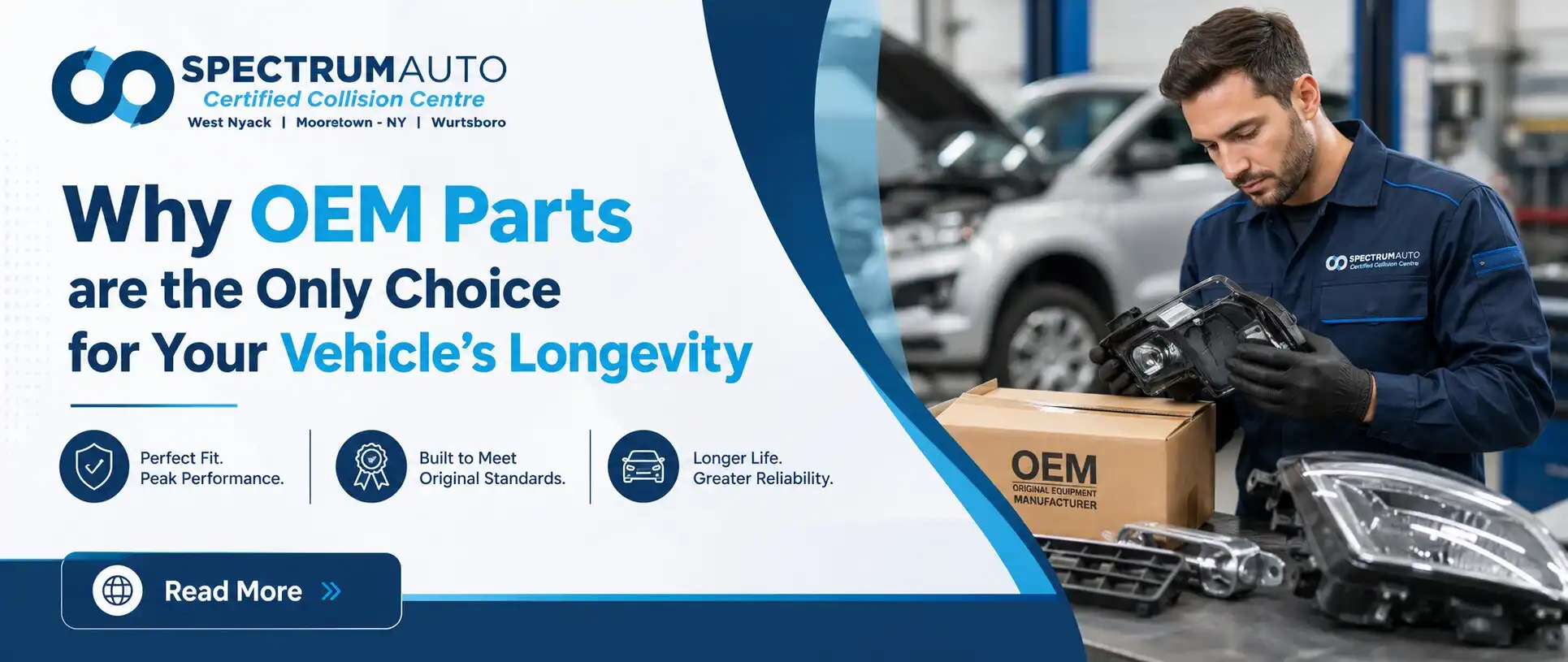
OEM stands for Original Equipment Manufacturer. These are the exact parts your vehicle came with from the factory. Same manufacturer. Same tolerances. Same materials. When your car leaves the assembly line, every component fits within tight engineering specifications. OEM parts keep it that way.
Aftermarket parts come from third-party manufacturers. They're made to fit — not necessarily to perform at the same level. Some are decent. Many cut corners you simply can't see.
The Fit Issue That Gets Overlooked
The most common problem with non-OEM parts is dimensional variance. It's not dramatic. We're talking fractions of a millimeter. But in a precision-engineered vehicle, those tiny gaps matter. A brake caliper that fits "close enough" is not the same as one built for your specific model. A body panel with slightly different contours weakens structural integrity after a collision.
When you bring your car in for mechanical repair services, a skilled technician does more than bolt on the cheapest available part. They check whether the part integrates correctly with every surrounding system. OEM parts remove that guesswork entirely.
Longevity Is About Precision, Not Just Mileage
Your engine, transmission, and suspension work as one interconnected system. Each component communicates with the ones around it. When you swap in a part that doesn't meet the original engineering standard, you introduce a weak link. That weak link has consequences.
Here's what it typically leads to:
- Premature wear — Aftermarket components that don't match OEM tolerances put extra stress on nearby parts. Those parts wear out faster.
- Warranty issues — Many manufacturer warranties face complications or become void when non-OEM parts are used in repairs.
- Lower resale value — Buyers and dealerships notice. A clean history of OEM repairs signals careful, responsible ownership.
- Compromised safety — Airbag systems, brake components, and structural panels rely on exact specifications. There's no room for "close enough" here.
The Real Cost of Going Cheap
Aftermarket parts look like savings on paper. For minor cosmetic repairs, they sometimes are. But for anything structural, mechanical, or safety-related, the math shifts fast.
A cheaper control arm that fails at 18 months instead of lasting the car's lifetime isn't a saving. It's a delayed expense with added risk. Reputable auto mechanic services are upfront about this. Shops that cut corners on parts tend to cost you more over the vehicle's lifetime, not less.
OEM parts also carry manufacturer-backed warranties. Aftermarket warranties vary. Some are solid. Many aren't. That difference in coverage shifts the financial risk onto you.
Situations Where OEM Parts Are Non-Negotiable
Not every repair requires OEM parts with the same urgency. But certain situations leave no room for compromise:
After a collision. Structural components, crumple zones, and safety systems must meet original manufacturer specifications. Aftermarket structural parts post-collision put your safety at risk in any future impact.
Engine and drivetrain work. Tolerances here are precise by design. The wrong gasket material or slightly off bearing dimensions can cause failures that cascade through the entire system.
Brake systems. Stopping power and heat dissipation get calculated around OEM components. Swapping in aftermarket rotors or pads changes those calculations in ways that aren't always visible until something goes wrong.
Electronic and sensor components. Today's vehicles are computer-driven systems. Aftermarket sensors, modules, and actuators frequently cause diagnostic problems. Codes won't clear. Systems stop communicating. Professional mechanical repair services often spend hours tracing a problem back to a single cheap aftermarket sensor.
What OEM-Certified Shops Do Differently
A shop with OEM certification isn't just hanging a badge. Their technicians train specifically on manufacturer repair procedures. They source parts through authorized channels. Repairs are documented against manufacturer standards. That documentation matters for warranties, insurance claims, and future resale.
Not every shop offering auto mechanic services works this way. When choosing where to take your vehicle, ask about parts sourcing. Ask about OEM certification. It's one of the most important questions you can ask.
The Right Parts Make the Difference
Knowing your vehicle was repaired correctly brings real peace of mind. Not just fixed, but restored to how it was built. OEM parts are central to that. Your car performs as designed, responds as expected, and holds its value over time.
Skipping on part quality might feel like a smart financial decision today. Over time, it rarely turns out that way.
Why Spectrum Auto Inc. Stands Apart
Spectrum Auto Inc. has served drivers across the Hudson Valley for over 30 years. Based in West Nyack, New York, the shop operates as an OEM Certified Collision Center and a Tesla-approved repair facility. Every technician on staff holds I-CAR® Platinum certification, one of the highest training standards in the industry. The team uses genuine OEM parts on every repair and follows factory procedures to restore vehicles to manufacturer specifications. Spectrum Auto has locations in West Nyack, Cortlandt, and Wurtsboro. They work directly with all major insurance carriers to keep the process simple for their customers.
Frequently Asked Questions
1. Are OEM parts always more expensive than aftermarket?
Not always. They cost more for certain components, yes. But the better question is total cost of ownership. OEM parts last longer, carry stronger warranties, and lower the risk of secondary failures. What looks cheaper upfront can cost significantly more over time.
2. Can I use aftermarket parts without voiding my car's warranty?
It depends on the manufacturer and the warranty terms. Non-OEM parts used on covered systems can complicate or void a claim. Check your owner's manual or talk to a certified shop before approving any aftermarket substitution.
3. How do I know if a repair shop is actually using OEM parts?
Ask for documentation. A reputable shop offering quality auto mechanic services will show you part invoices without hesitation. OEM-certified shops keep records that support warranty claims and insurance documentation.
4. Do OEM parts matter for older vehicles?
Yes, though priorities shift with age. For vehicles still under warranty, OEM parts are the right call. For older vehicles, focus on safety-critical systems first: brakes, suspension, and steering. These directly affect how your car protects you. On high-mileage vehicles, cosmetic components offer more flexibility.